
Running a small business means wearing a lot of hats. You’re the owner, the accountant, the customer service team and, more often than not, the marketing department too. With limited time and money, it’s easy to feel overwhelmed by everything you’re “supposed” to be doing online.
Here’s the good news: you don’t need to do everything. You need to do the right things, consistently. Small businesses have real advantages online: you can move fast, speak personally to your customers, dominate your local area and build genuine relationships that big brands can’t match.
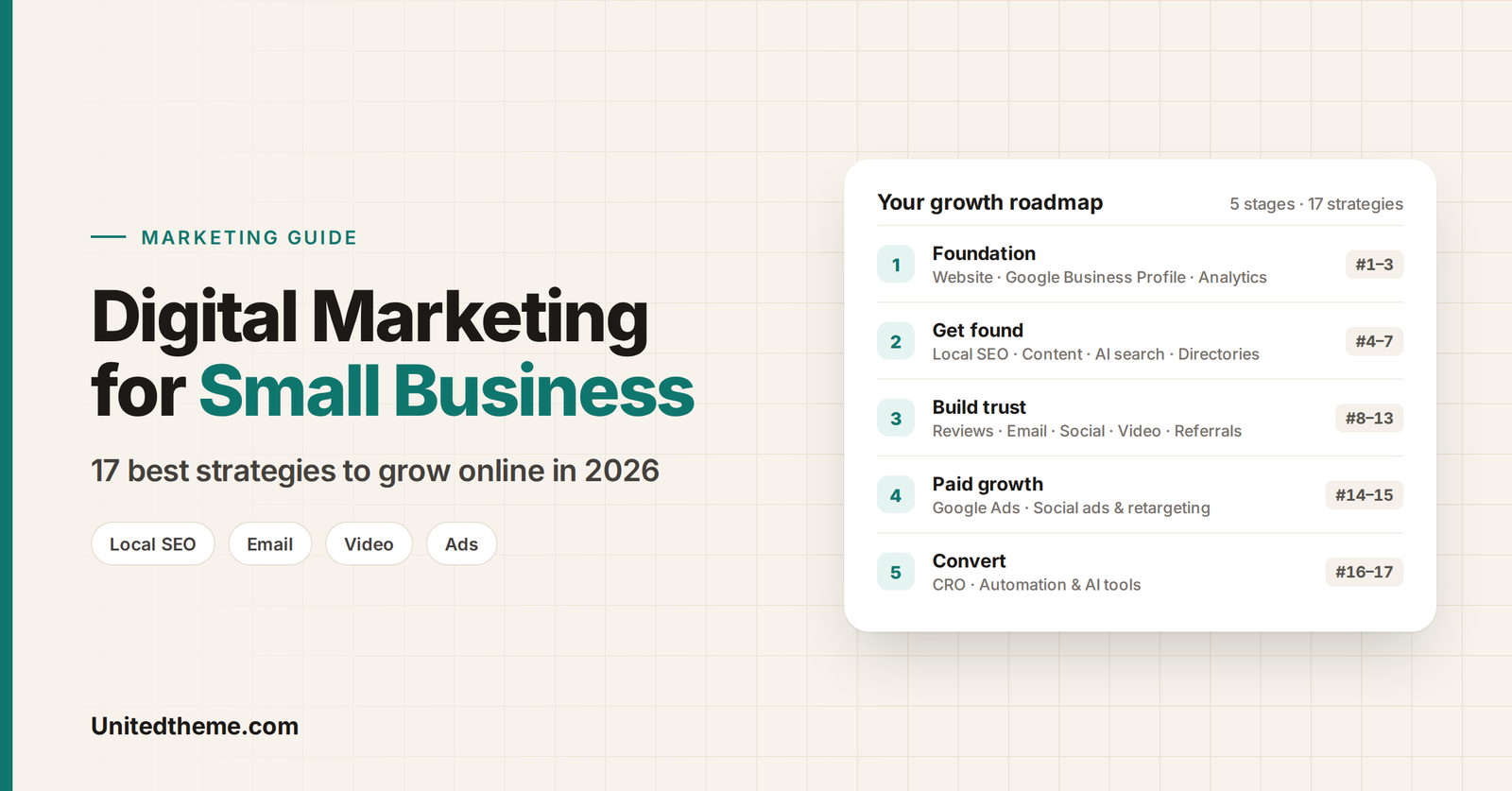
In this guide, we’ll walk through 17 of the best digital marketing strategies for small businesses, grouped into clear stages so you know where to start. We’ll finish with a practical budget framework and a 90-day action plan.
In this guide:
- Why digital marketing matters for small businesses
- Before you start: goals, audience and budget
- 17 proven strategies, from foundations to growth
- How to split your marketing budget
- A 90-day digital marketing plan
- Common mistakes to avoid
Why Digital Marketing Matters for Small Businesses
Your customers search before they buy. Whether they’re looking for a plumber, a café, an accountant or a handmade gift, most people start online by searching Google, checking maps, reading reviews, scrolling social media or, increasingly, asking an AI assistant for recommendations.
Digital marketing helps you:
- Get found at the exact moment people are looking for what you offer
- Compete with bigger brands by targeting niche and local audiences
- Build trust through reviews, helpful content and consistent communication
- Measure results precisely, so every dollar works harder
- Start small and scale what works, without big upfront costs
Before You Start: Goals, Audience and Budget
Jumping straight into tactics is the most common small business marketing mistake. Spend an hour on these three questions first.
1. What’s your goal? Be specific: “Get 20 new booking enquiries per month,” “Grow online sales by 30% in six months” or “Get 50 five-star Google reviews this year.” Clear goals tell you which strategies to prioritize.
2. Who’s your ideal customer? Write a short profile: who they are, where they live, what problem they need solved, where they spend time online and what makes them choose one business over another.
3. What can you invest? Decide on a realistic monthly budget of both money and time. Some strategies cost little money but take time (SEO, social media); others cost money but save time (ads, outsourcing).
With these answers in hand, let’s look at the strategies.
Stage 1: Build Your Digital Foundation
These strategies come first because everything else depends on them.
1. Build a Fast, Mobile-Friendly Website You Own
Your website is your digital storefront and the one marketing asset you fully control. Social media platforms change their rules; your website doesn’t.
A great small business website should:
- Load fast, especially on mobile phones
- Clearly explain what you do, who you serve and where you’re located within seconds
- Make contacting you effortless, with click-to-call buttons, contact forms, booking tools or WhatsApp links
- Build trust with reviews, photos of real work, team photos and clear pricing where possible
- Be easy to update, so you can add offers, posts and new services yourself
WordPress is a popular choice for small business sites because it’s flexible, affordable and gives you full ownership. A lightweight, professionally designed theme gets you most of the way there. You can explore fast, Site Editor-ready options at Unitedtheme.com.
Quick win: Test your homepage on your phone. Can someone find your phone number, location and main service in under five seconds? If not, fix that first.
2. Claim and Optimize Your Google Business Profile
For local businesses, your Google Business Profile (formerly Google My Business) is arguably your most important free marketing tool. It controls how you appear in Google Maps and in the local results at the top of Google Search.
How to optimize it:
- Claim and verify your profile at business.google.com.
- Choose the most accurate primary category, then add relevant secondary categories.
- Complete every field: hours, services, products, service areas, attributes, website and booking links.
- Upload real photos regularly: your storefront, team, products and completed work.
- Post updates and offers to show activity and promote seasonal deals.
- Answer questions and reply to every review.
- Keep your name, address and phone number (NAP) identical everywhere online.
3. Set Up Analytics and Tracking From Day One
If you can’t measure it, you can’t improve it. Before spending on marketing, set up:
- Google Analytics 4 to understand website visitors and which channels bring results
- Google Search Console to see how you appear in Google Search
- Key events (conversions) for enquiries, calls, bookings and purchases
- UTM parameters on links in emails, social posts and ads, so you know exactly where traffic comes from
Helpful guides: How to Install Google Analytics in WordPress and How to Use Google Analytics 4 to Grow a WordPress Blog.
Stage 2: Get Found by the Right People
4. Invest in Local SEO
Local SEO helps you rank when nearby customers search for services like yours, such as “dentist near me” or “bakery in Kathmandu.”
Key local SEO tactics:
- Create a page for each core service, and for each location or area you serve, with unique, helpful content (not copy-pasted text with the town name swapped).
- Build consistent citations in reputable directories and local business listings, with exactly the same NAP details.
- Earn local links from chambers of commerce, local news sites, sponsorships, events and partner businesses.
- Add LocalBusiness schema markup to your website so search engines clearly understand your business details. Many WordPress SEO plugins can do this for you.
- Embed a Google Map and clear directions on your contact page.
5. Publish Helpful Content That Answers Customer Questions
Content marketing means creating useful information your customers are already searching for. It builds trust, improves SEO and positions you as the expert.
Start with the questions customers ask you every week. A landscaper could write “How Often Should I Water a New Lawn?”, an accountant “What Expenses Can Freelancers Deduct?” and a bakery “How Far in Advance Should I Order a Wedding Cake?”
Content tips for small businesses:
- Write for people first, using plain language and real examples.
- Include original photos, local insights and your own experience. That’s something AI-generated content and big competitors can’t easily copy.
- Add a clear next step at the end of every post (call, book, buy, subscribe).
- Update older posts regularly to keep them accurate.
- Quality beats quantity: two excellent posts a month beat ten rushed ones.
6. Optimize for AI Search and Answer Engines
More and more people ask AI assistants and AI-powered search results for recommendations: “What’s the best family-friendly restaurant near me?” or “Which accounting software should a small business use?” Getting mentioned in those answers is a new, fast-growing opportunity, sometimes called answer engine optimization (AEO) or generative engine optimization (GEO).
How to improve your visibility in AI answers:
- Answer common questions clearly and directly on your website, using FAQ sections and question-style headings.
- Keep your business information consistent across your website, Google Business Profile, directories and social profiles.
- Earn reviews and mentions on trusted third-party sites, which AI systems often draw from.
- Use structured data (schema markup) to describe your business, products, services and FAQs.
- Demonstrate real expertise: author bios, credentials, case studies and original data.
Track it: In Google Analytics 4, AI assistants often appear as referral sources, so watch your Traffic acquisition report for them.
7. List Your Business in Relevant Directories and Marketplaces
Beyond Google, customers find businesses on platforms like Bing Places, Apple Business Connect, Yelp, Facebook, TripAdvisor (for hospitality), industry-specific directories and local listing sites. Marketplaces like Etsy, Amazon or local delivery and booking apps can also bring new customers.
Prioritize the platforms your customers actually use, keep listings accurate, and link back to your website where possible.
Stage 3: Build Trust and Relationships
8. Collect and Manage Online Reviews
Reviews are modern word-of-mouth. They influence buying decisions, help local SEO and make you more visible in maps and AI recommendations.
How to get more reviews:
- Ask at the right moment, just after a successful job or a happy customer interaction.
- Make it easy with a direct review link or QR code on receipts, invoices, emails and your counter.
- Reply to every review, positive or negative, politely and professionally.
- Handle negative reviews calmly: acknowledge the issue, offer to resolve it offline, and follow up.
- Showcase reviews on your website and social media.
Important: Never buy fake reviews or offer incentives in exchange for positive reviews. It violates platform policies (including Google’s) and, in many countries, consumer protection laws.
9. Build an Email List and Send Regular Newsletters
Email is one of the most cost-effective digital marketing channels, and your email list is an audience you own, unaffected by social media algorithm changes.
How to start:
- Choose an email platform such as MailerLite, Mailchimp, Kit (formerly ConvertKit) or Brevo.
- Offer something valuable in exchange for an email address: a discount, guide, checklist, free consultation or early access to sales.
- Add sign-up forms to your website, checkout, Wi-Fi login (for physical locations) and social profiles.
- Send a welcome email sequence that introduces your business and makes a first offer.
- Send regular newsletters (weekly, bi-weekly or monthly) with tips, news, offers and customer stories.
Stay compliant: Only email people who have opted in, include your business address and an easy unsubscribe link, and follow local laws such as GDPR or CAN-SPAM where they apply.
10. Use Social Media Strategically (Pick One or Two Platforms)
You don’t need to be on every platform. Choose the one or two where your customers spend the most time, and do them well:
| Platform | Often best for |
|---|---|
| Local businesses, community groups, events, older audiences | |
| Visual businesses: food, fashion, beauty, travel, design | |
| TikTok | Younger audiences, entertaining and behind-the-scenes content |
| B2B services, consultants, professional services, hiring | |
| Home, wedding, fashion, food and DIY businesses with long-term search traffic | |
| YouTube | How-to content, product demos, long-term discoverability |
Social media tips:
- Follow the 80/20 rule: about 80% helpful, entertaining or behind-the-scenes content and 20% promotional.
- Show the people behind the business. Personality builds trust.
- Respond quickly to comments and messages, since many customers now use DMs to ask questions and book.
- Batch-create content once a week and schedule it with tools like Meta Business Suite or Buffer.
11. Embrace Short-Form Video
Short vertical videos on Instagram Reels, TikTok, YouTube Shorts and Facebook Reels are one of the best ways to reach new people organically.
Easy video ideas for small businesses:
- Behind the scenes: how you make, prepare or deliver your product
- Before-and-after transformations
- Quick tips and answers to common questions
- Customer stories and testimonials (with permission)
- Meet the team
- New product or service showcases
You don’t need professional equipment. A smartphone, natural light, clear audio and a strong hook in the first two seconds go a long way.
12. Partner With Local Businesses and Micro-Influencers
Partnerships put your business in front of trusted, established audiences.
- Cross-promote with complementary local businesses (a florist and a wedding photographer, or a gym and a healthy café).
- Co-host events, workshops or giveaways.
- Work with micro-influencers, local creators with smaller but highly engaged audiences, who are often more affordable and authentic than big influencers.
- Sponsor local teams, charities or events, which builds goodwill and often earns local links and mentions.
Transparency matters: Influencers should clearly disclose paid partnerships and gifted products, as required by advertising rules in many countries.
13. Launch a Referral and Loyalty Program
Your happy customers are your best marketers. Reward them for spreading the word:
- Referral rewards: “Give $10, get $10,” or a free service after a set number of referrals.
- Loyalty programs: points, punch cards (digital or physical), member-only discounts or VIP early access.
- Make sharing easy with unique referral links or codes, and thank customers personally.
Stage 4: Accelerate Growth With Paid Marketing
14. Run Targeted Google Ads
Google Ads shows your business to people actively searching for what you sell, which makes it powerful for capturing ready-to-buy customers.
Tips for small budgets:
- Start with Search campaigns targeting high-intent keywords (“emergency electrician [city],” “buy [product] online”).
- Target your service area precisely by location and radius.
- Use negative keywords to avoid paying for irrelevant clicks.
- Send traffic to a focused landing page, not your homepage.
- Track calls, forms and sales as key events so you know your cost per customer.
- Check Local Services Ads, if available for your industry and country. These pay-per-lead ads appear at the very top of results with a Google screening badge.
15. Use Paid Social Ads and Retargeting
Meta (Facebook and Instagram) ads, plus TikTok and LinkedIn ads, let you reach people based on location, interests, demographics and behavior, which is great for building awareness and promoting offers.
Retargeting is especially effective for small budgets: it shows ads to people who’ve already visited your website or engaged with your content, reminding them to come back and buy.
Tips:
- Start with a small daily budget and test 2–3 ad variations.
- Use real photos and videos of your business. Authentic content often outperforms polished stock imagery.
- Install the relevant tracking pixels (with proper cookie consent where required) to measure results and build retargeting audiences.
Stage 5: Convert, Automate and Improve
16. Optimize Your Website for Conversions
More traffic is only valuable if visitors take action. Conversion rate optimization (CRO) means improving your site so more visitors become customers.
Quick conversion wins:
- One clear call to action per page (“Book a Free Quote,” “Order Now,” “Call Today”)
- Short, simple forms: ask only for what you need
- Trust signals near CTAs: reviews, guarantees, certifications and secure payment badges
- Fast page speed: slow sites lose customers (see our guide on reducing TTFB in WordPress)
- Live chat or WhatsApp buttons for instant questions
- Clear pricing or “starting from” prices where possible
- Test changes one at a time and measure the results in GA4
17. Use Marketing Automation and AI Tools (Wisely)
Automation and AI can save small business owners hours every week:
- Email automation: welcome series, abandoned cart reminders, birthday offers, review requests
- Social media scheduling: plan a month of content in an afternoon
- AI writing assistants: brainstorm ideas, draft social captions, outline blog posts and summarize customer feedback
- Chatbots: answer common questions and capture leads outside business hours
- CRM tools: keep track of leads, customers and follow-ups
Use AI as an assistant, not a replacement. Always review, fact-check and personalize AI-generated content. Your real experience, local knowledge and personal voice are your biggest competitive advantages.
How to Split Your Small Business Marketing Budget
There’s no one-size-fits-all budget, but this simple framework helps you allocate resources wisely. Adjust it to your goals and industry.
| Area | Suggested share | What it covers |
|---|---|---|
| Foundation (website, hosting, tools) | 20–30% | Website improvements, hosting, email platform, analytics |
| Content and SEO | 20–30% | Blog posts, local SEO, photos and video |
| Paid advertising | 25–40% | Google Ads, Meta ads and retargeting |
| Relationships and retention | 10–20% | Email marketing, referral rewards, loyalty programs, partnerships |
Start small, then scale what works. Review results monthly and shift budget from channels that underperform to those that bring customers at a profitable cost.
A 90-Day Digital Marketing Plan for Small Businesses
| Timeline | Focus | Key actions |
|---|---|---|
| Days 1–30 | Foundation | Set goals and budget; fix website speed, mobile layout and CTAs; claim and optimize Google Business Profile; install GA4 and Search Console; set up key events |
| Days 31–60 | Visibility and trust | Publish 2–4 helpful posts; build service/location pages; set up review requests; launch email sign-up and welcome sequence; post consistently on 1–2 social platforms |
| Days 61–90 | Growth | Launch a small Google Ads or Meta ads test; start retargeting; begin short-form video; reach out to 2–3 local partners; review analytics and double down on what works |
After 90 days, repeat the cycle. Keep what’s working, improve what’s not, and add one new strategy at a time.
Common Digital Marketing Mistakes Small Businesses Make
- Trying to do everything at once: focus on a few strategies and do them well.
- Ignoring the website: sending traffic to a slow, confusing site wastes your marketing budget.
- No tracking: without analytics, you can’t tell what’s working.
- Inconsistent posting: marketing works through consistency, not occasional bursts.
- Giving up too early: SEO and content take months; ads need time to optimize.
- Copying big brands: your advantage is being personal, local and authentic.
- Neglecting existing customers: retention and referrals are often cheaper than finding new customers.
Frequently Asked Questions
What is the best digital marketing strategy for a small business?
For most local businesses, the best starting point is a fast website plus an optimized Google Business Profile and a steady flow of reviews. From there, add email marketing, helpful content and targeted ads based on your goals.
How much should a small business spend on digital marketing?
It depends on your industry, goals and growth stage. Many small businesses set aside a percentage of revenue for marketing, but the most important thing is to start with a budget you can sustain, track results carefully and increase spending on channels that prove profitable.
Can I do digital marketing myself?
Yes. Many strategies, including Google Business Profile, reviews, social media and email marketing, are very manageable for business owners. Consider outsourcing technical or time-intensive tasks like website development, advanced SEO and paid ads management as you grow.
How long does it take to see results from digital marketing?
Paid ads can bring results within days. Google Business Profile improvements and reviews often help within weeks. SEO and content marketing usually take several months to build momentum, but deliver lasting, compounding results.
Is social media enough to market a small business?
Social media is valuable, but relying on it alone is risky because you don’t control the platform or its algorithm. Combine it with assets you own, like your website and email list.
What is local SEO and why does it matter?
Local SEO helps your business appear when people nearby search for your products or services, especially in Google Maps and local search results. For businesses serving a specific area, it’s one of the most valuable marketing investments.
Should small businesses use AI for marketing?
Yes, as a helpful assistant. AI tools can speed up content ideas, drafts and customer service. Always review AI output for accuracy and add your own expertise and voice.
Recommended Video Tutorials
These YouTube videos offer practical advice on small business marketing:
- Digital Marketing 101 (A Beginner’s Guide to Marketing in 2026), by Adam Erhart: a clear introduction to digital marketing fundamentals. youtube.com/watch?v=CBUF5V4iNgU
- 5 Best Marketing Strategies for Small Business 2026 (Proven & Profitable), by LYFE Marketing: practical strategies for small business owners. youtube.com/watch?v=yau81o9ovew
- The Only Marketing Strategy That Is Working in 2026, by Neil Patel: a recent take on what’s working in marketing now. youtube.com/watch?v=UlfniLzuwa0
- Best Instagram Marketing Strategy for Small Business 2026, by Alex Cattoni: how to use Instagram effectively as a small business. youtube.com/watch?v=od1a9WtzjHo
- 5 Secrets to Optimize Your Google Business Profile in 2026, by Sterling Sky Inc: expert local SEO tips for your Business Profile. youtube.com/watch?v=30zw1Y_mS4g
- (2026) Google Business Profile Optimization Tutorial for Beginners, by Mariah Magazine: a beginner-friendly Business Profile walkthrough. youtube.com/watch?v=EKmhrdTR-OM
Editor’s tip: Paste any of these YouTube URLs on its own line in the WordPress block editor to embed the video automatically.
Conclusion
Digital marketing doesn’t have to be complicated or expensive. The most successful small businesses build a strong foundation, focus on a few high-impact strategies and stay consistent.
Here’s a quick recap of the 17 strategies:
- Build a fast, mobile-friendly website
- Optimize your Google Business Profile
- Set up analytics and tracking
- Invest in local SEO
- Publish helpful content
- Optimize for AI search
- List in relevant directories and marketplaces
- Collect and manage reviews
- Build an email list
- Use social media strategically
- Embrace short-form video
- Partner with local businesses and micro-influencers
- Launch referral and loyalty programs
- Run targeted Google Ads
- Use paid social ads and retargeting
- Optimize your website for conversions
- Use automation and AI wisely
Start with the foundation, follow the 90-day plan, measure your results and keep improving. Small, consistent steps add up to big growth.
Need a professional website to power your marketing? Explore the fast, modern WordPress themes at Unitedtheme.com.
Want a Website That Actually Brings You Customers? Let Our WordPress Developers Build It
Every digital marketing strategy leads back to one place: your website. If it’s slow, confusing or hard to update, your marketing budget leaks away. At Unitedtheme, we offer professional WordPress development services for small businesses: fast, mobile-first websites, high-converting landing pages, local SEO-ready structure and schema, booking and e-commerce integrations, GA4 and conversion tracking setup, and easy-to-edit layouts you can manage yourself. We build websites designed to turn visitors into enquiries, bookings and sales. If you’re ready for a website that works as hard as you do, hire Unitedtheme’s expert WordPress developers and let’s build it together.
Keep Your Business Website Fast, Secure and Converting, Every Month
Marketing works best when the website behind it is always fast, secure and up to date. With Unitedtheme’s WordPress care plans and retainers, our team looks after your website on an ongoing basis: regular updates, speed and Core Web Vitals monitoring, security hardening, backups, tracking checks, landing page improvements, bug fixes and continuous enhancements, all handled by WordPress experts who know your site inside out. Instead of losing leads to broken forms or slow pages, you get a dedicated team keeping everything running smoothly while you focus on your customers. Explore Unitedtheme’s WordPress retainer plans and give your business website the ongoing care it deserves.


Leave a Reply